
Behind the Scenes: Technical Safeguards Used by Casino Software Providers to Maintain Equitable Play Standards
Casino software providers build the digital infrastructure that powers online gaming platforms, and their systems incorporate multiple layers of technology designed to deliver consistent random outcomes across different devices and operating environments. These companies develop random number generators that operate independently of player inputs or previous results, which ensures each spin, card draw, or dice roll remains statistically independent. Data from regulatory filings shows that providers must demonstrate consistent performance metrics before their games receive approval for distribution on licensed sites.
Core Random Number Generator Architecture
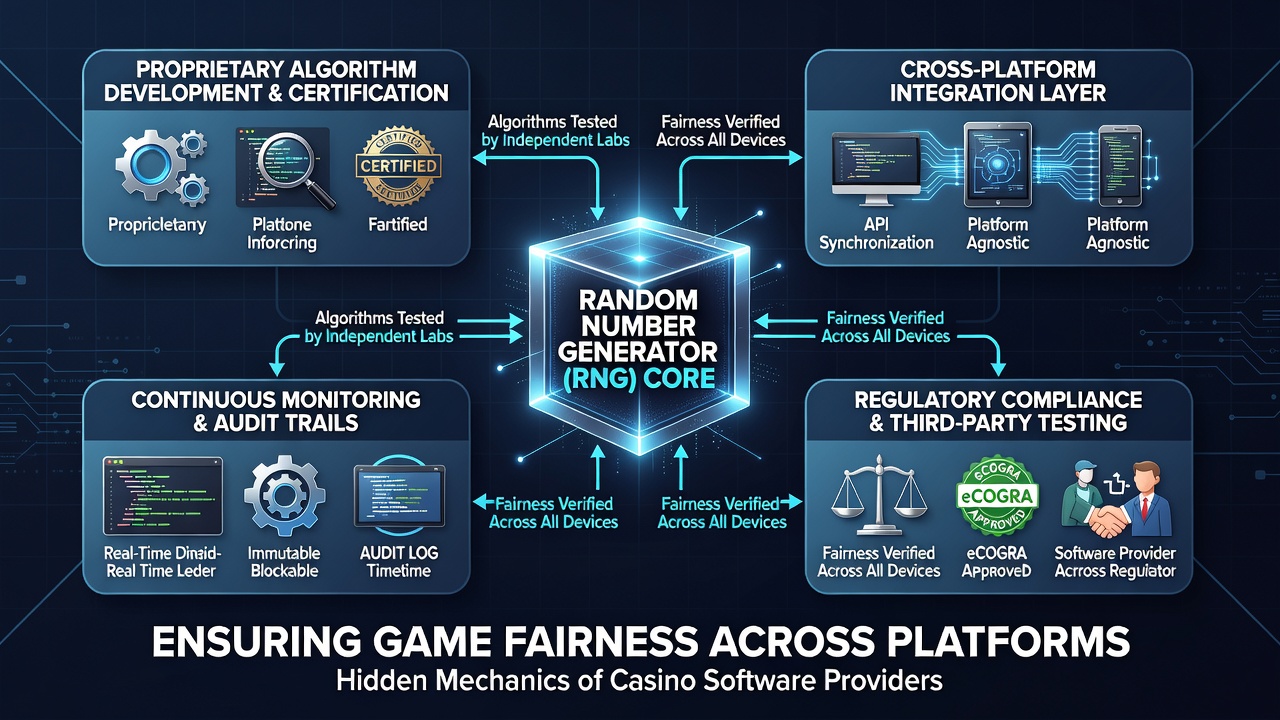
Providers implement pseudorandom number generators seeded with high-entropy sources such as hardware-based noise collectors and system timestamps, and these algorithms undergo continuous testing to verify uniform distribution across the entire output range. Researchers at technical laboratories run millions of simulated cycles to confirm that deviation rates stay within acceptable statistical thresholds, while any anomalies trigger immediate code reviews and algorithm adjustments. Because the same RNG core must function identically on desktop browsers, mobile applications, and tablet interfaces, developers compile platform-specific wrappers that call the central generator without altering its mathematical properties.
Independent Testing and Certification Procedures
Third-party laboratories conduct evaluations that include source code reviews, live environment testing, and long-term statistical analysis before issuing certification reports. Organizations such as iTech Labs and Gaming Laboratories International maintain standardized protocols that measure return-to-player percentages against declared values, and these reports become public documents referenced by licensing authorities. In June 2026, several jurisdictions plan to introduce updated testing intervals that require quarterly re-certification for high-volume titles, which will increase the frequency of audits performed on existing game libraries. Providers that already maintain automated monitoring dashboards can adapt to these schedules without disrupting live operations.
Cross-Platform Consistency Mechanisms
Software engineers create unified codebases that compile to native formats for iOS, Android, and web browsers, yet the underlying probability tables and payout calculations remain identical regardless of the execution environment. Synchronization servers track game state across sessions so that interrupted play resumes from the exact point where connectivity dropped, and these servers log every transaction with cryptographic timestamps that prevent retroactive alteration. Observers note that mobile network variability once posed challenges for real-time fairness verification, but modern providers now embed client-side verification tokens that allow servers to confirm integrity even during brief disconnections.
Security Layers Protecting Game Integrity
Encryption protocols secure both the transmission of game data and the storage of RNG seed values, while access control systems restrict modification rights to authorized personnel only. Penetration testing performed by independent security firms identifies potential entry points that could theoretically influence outcomes, and remediation occurs before any affected title reaches production servers. According to guidelines published by the Malta Gaming Authority, providers must retain detailed audit trails for a minimum of five years, which enables regulators to reconstruct events if discrepancies arise during routine compliance checks.
One documented case involved a provider that discovered a memory leak in an older mobile library; the issue was isolated to specific device models and corrected through an over-the-air update that left RNG behavior unchanged across all platforms. Such incidents highlight why continuous integration pipelines now include automated fairness regression tests that run after every code commit.
Regulatory Reporting and Transparency Requirements
Licensing bodies in multiple regions demand monthly submission of aggregated performance data that includes theoretical versus actual return percentages for each certified title. The New Jersey Division of Gaming Enforcement requires providers to supply raw RNG output samples upon request, which allows statisticians to perform independent verification outside the company's own laboratories. Industry associations such as the International Association of Gaming Regulators coordinate information sharing between jurisdictions so that a certification granted in one territory can serve as supporting documentation in another, reducing duplication while preserving local oversight standards. Figures released by Gambling Research Australia indicate that titles subjected to multi-jurisdictional audits maintain lower complaint ratios than those certified under single-regulator frameworks.
Conclusion
Casino software providers combine algorithmic design, independent verification, and regulatory compliance into integrated systems that support consistent game outcomes across diverse platforms. Ongoing technical refinements and evolving audit schedules, including those scheduled for implementation by June 2026, continue to strengthen these safeguards while maintaining operational continuity for licensed operators worldwide.